

Learn how to become a data analyst and discover everything you need to know about launching your career, including the skills you need and how to learn them.
Are you fascinated by the power of data to drive decision-making and solve complex problems? You’re not alone. In our increasingly data-driven world, the role of a data analyst has never been more crucial. From healthcare and finance to marketing and sports, data analysts are the unsung heroes behind the scenes, turning raw data into actionable insights.
Get started on your way to becoming a Data Analyst by starting one of our Data Analyst career tracks.
If you want to pursue a career as a data analyst, there are five main steps you’ll need to take:
In this post, we’ll take a look at each of these points in more detail, giving you everything you need to know to get started on your journey to becoming a data analyst. You can find out about the top analytics careers in a separate post.


Below, we’ve outlined how to become a data analyst from scratch. Much of this assumes that you’re coming to the profession fresh, although much will be relevant to those with some of the fundamentals already.
How long it takes to become an analyst depends very much on the individual. Those with little existing knowledge and experience can master the skills within a few months. For others, it will take several years of study.
The popular belief is that to start learning data analysis, one has to be good at mathematics, statistics, or programming. While it’s true that a background in these fields provides a solid technical basis, it doesn’t mean that a career in data analysis is unapproachable for people from other educational and professional backgrounds.
Learning to analyze data will require some intensive study, dedication, and a great deal of practice. You have to maintain a certain level of optimism even when you are stuck, exhausted, discouraged, or can’t see any progress.An aspiring data analyst should be creative and curious about data, have an exploratory mindset, be able to think analytically, be able to work both independently or in a team and be willing to dedicate the necessary time and effort. These are all qualities that will help ensure your success.
You’ll want to start by mastering some basic data analysis skills, such as the fundamentals of statistics, which covers topics such as including measures of center and spread, probability distributions, and hypothesis testing.
You can also start with things like data analysis in spreadsheets to get a feel of collecting and wrangling, and learn how exploratory data analysis in Power BI and other tools works.
Data analysts will usually work with several programming languages, which means there is no wrong or right choice. Essentially, you’ll need to master SQL for querying and manipulating databases, but you’ll then need to choose between R and Python for your next programming language.
You can find a comparison of Python vs R for data analysis in a separate post. You can also learn to become a data analyst with R or Python with our tracks.
Essentially, at this point, you’ll be learning how to import, clean, manipulate, and visualize data with your preferred programming language. You’ll discover some of the libraries that can help you’ll with various tasks and grow your programming skills.
Most employers will want to see evidence of your qualifications in data analysis. There are various routes to this, and much of it depends on your current level of education and familiarity with the subject matter.
For example, several universities offer bachelor’s and master’s degrees in data analytics, but undertaking this path will require a substantial investment of both time and money: you’ll need to devote 2-4 years to full-time study, and it could cost anywhere from $30,000-$200,000.
Additionally, if you enroll in a bachelor’s degree program, you’ll be required to fulfill course requirements outside of data analytics. A degree isn’t necessary to become a data analyst, but it can certainly help. Similarly, choosing a data science bootcamp is a popular choice, although again, the price can be somewhat prohibitive for many.
Learning online with Dataupto gives you the flexibility to learn from wherever you are in the world, provided you have a computer and internet access. What’s more, learning through an online program is dramatically less expensive than learning at a university: for example, you can complete our Data Analyst Career Track and data analyst certification in less than a year at a fraction of the cost of university study, you still get hands-on experience, and can even get fully certified as a data analyst.
A comparison of different data analyst qualification routes
An ideal online self-study program includes an exhaustive and well-balanced curriculum that covers the most important data analysis topics and techniques – along with plenty of opportunities to practice them.
So, if you’re looking for how to become a data analyst with no experience, your learning path will look something like this:
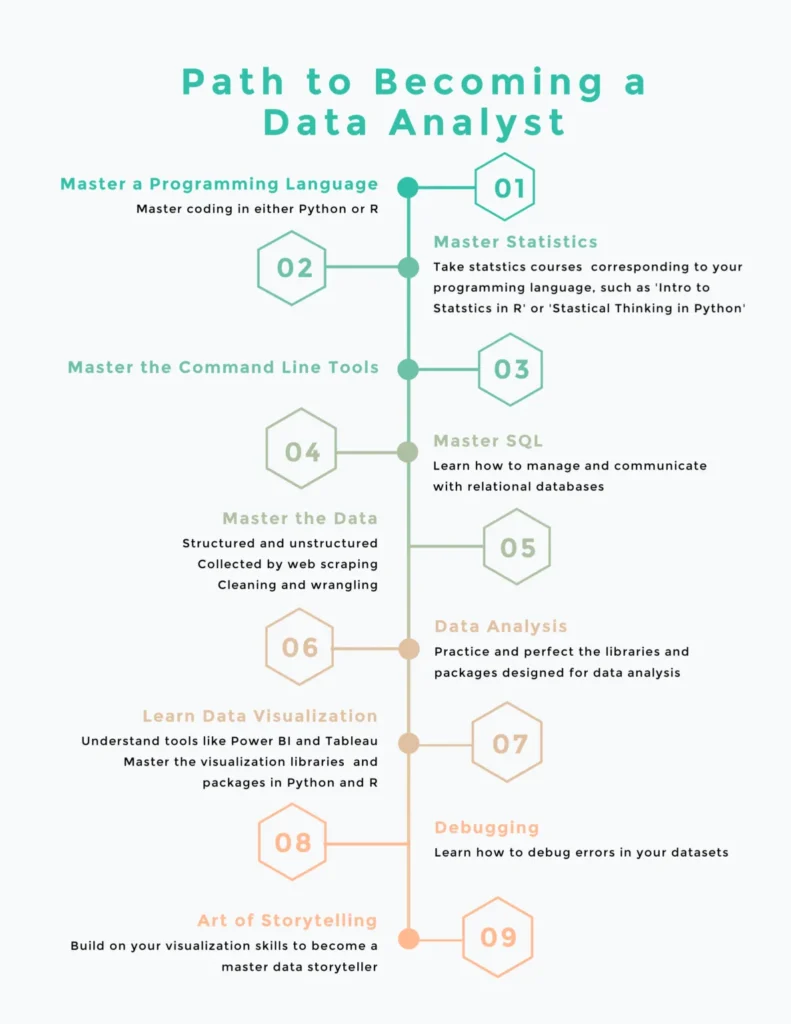
Once you’ve mastered some of the essential skills, you’ll need to start developing them on your own. There are a variety of ways you can do so:
You will have abundant opportunities to put your new skills to work by doing various exercises and completing the data analysis projects suggested by your curriculum. Practicing your skills and solving mock or real-world problems will give you a solid basis for your future work experience.
At this stage, having access to some real, clean datasets and preselected ideas to explore will help maintain your interest in learning and avoid the distractions of additional searching or brainstorming. You can look at our range of data analytics projects to help you put your skills to the test.
However, the time will come for you to prepare yourself for real-world work experience as a data analyst, and you’ll need to proceed with more advanced studies: In order to best “sell” yourself, you’ll want to showcase your ability to work and research independently to a potential employer.
Hence, you will need to undertake individual projects where everything will be your responsibility: selecting the topic, fetching the necessary data, contemplating the direction of your research, designing the project structure, making and checking hypotheses, effectively communicating your findings, and laying out the way forward.
As a result, individual projects usually take much more time than the guided ones, but they will help you to stand out from the crowd when applying for a job.
As soon as you come up with a good topic to develop in your project, your next step is to find the relevant data to explore. For this purpose, there are numerous online repositories offering a variety of free datasets. As well as Dataupto projects, you can use:
| Qualification Route | Pros | Cons |
|---|---|---|
| University Degree | – Comprehensive curriculum – Networking opportunities – Recognized credential |
– Time-consuming (2-4 years) – Expensive ($30,000-$200,000) – May include unrelated courses |
| Online Bootcamps | – Focused curriculum – Shorter duration (3-6 months) – More affordable |
– Less recognized than a degree – Intense pace – Limited networking |
| Self-Study (Online Courses) | – Flexible schedule – Wide range of topics – Cost-effective |
– Requires self-discipline – Credentials varies by provider – Hands-on experience depends on the course |
| Certifications | – Validates specific skills – Quick to complete – Widely recognized |
– May require prior experience – Costs can add up – Narrow focus |
By this point, you should be well on your way to becoming a data analyst. However, to get in front of potential employers, you’ll need to have a portfolio of your work. You can check out our full guide on building a data science portfolio for some inspiration.
When you first come to the job market as an entry-level data analyst, it’s understandable if your initial portfolio of projects contains mostly guided capstone projects from your online boot camp or data-related university work. At this stage, it is also perfectly fine and expected to have many disparate boot camp projects on different studied concepts, showing a variety of tools and techniques.
However, you want to use your portfolio to make your passions and interests shine through. Tell a story about how your skills have developed and where your expertise are. You want to demonstrate both your technical and soft skills and design it to appeal to your readers.
Ideally, you want to avoid cookie-cutter projects that everyone has, and instead, focus on the projects you’ve completed that are most interesting to you. The more you develop your portfolio, the more you can remove the broad-scope, common projects.
While there is no exact formula, you can think about including some of the following elements in your portfolio as you work towards becoming a data analyst:
When you feel that you are ready to explore a specific business area of your choice, you may start focusing on gaining domain knowledge and making individual projects related to that particular sphere.
You can keep your portfolio of data analysis projects on DataLab, GitHub, or Kaggle free of charge. They are not the only free platforms for hosting such portfolios, but these two are widely popular and are the best choice for an entry-level data specialist as they ensure good visibility for your projects. You might also want to consider creating a personal website.
Once you’re confident in your abilities and portfolio, it’s time to think about how to get a job as a data analyst. We’ve got some tips below:
Before starting your job hunting process, you may want to make a quick revision of your data analyst skills and compare it with the requirements for this role in the modern market.
A good place to start is to take a look at the descriptions of several job positions for a data analyst and write down the skills that are currently most in demand. You can check out our data analyst resume templates to give you some inspiration.
To get a job as a data analyst, here are the basic technical skills that companies usually expect to see:
If the list above looks overwhelming to you, don’t feel discouraged; you likely won’t need all these skills for every data analyst job. Usually, each company looks for a different set of skills in a suitable candidate.
The best way to find out the specific requirements of a certain employer is to read the corresponding job description. If, at this point, you feel that you lack some crucial skills, consider upskilling.
Finally, don’t forget that there are also some important data analyst soft skills:
Now it’s time to write your resume. At a first glance, it may seem to be an easy task. However, in reality, it’s worth dedicating some time and effort to building a compelling and professional-looking resume that can capture the attention of recruiters. You may find the following article helpful: Tips to build your data scientist resume.
While this article talks mostly about creating a resume for a data scientist role, the majority of tips from here are applicable to any other data-related profession. Let’s briefly outline the most important suggestions from the article:
The order of appearance of the last four sections depends on your real relevant experience and, hence, on what you want to showcase first.
Your LinkedIn/Kaggle/Medium/GitHub or any other relevant professional profile should be in line with your data analyst resume or even represent your resume in miniature. The main goal here is to let your readers know that you are a data analyst, even if you don’t have real work experience yet in this sphere.
In other words, you have to promote yourself and create a unique personal brand to enter the competitive labor market of data analysis.
Below are some useful tips:
Some of the suggestions for writing an efficient resume are also applicable here. Be concise but informative, use plain but efficient language, check for errors and typos, double-check your contact details, and avoid including your skill level.
One great way to showcase your skills is with a data analyst certification. This can demonstrate to businesses that you have the skills to effectively answer critical questions and provide vital information to stakeholders, as well as effectively visualize and communicate your results.
Since you are trying to enter a completely new sphere, you need to start growing your professional network in the data world. Creating a compelling LinkedIn, GitHub, or similar profile is a great first step.
However, you can be even more proactive by joining various data communities or groups, participating in online and live meetup events and conferences, following and connecting with the right people on social networks, commenting on social media data-related content, and publishing articles on data analysis topics.
Surround yourself with data professionals can help, and the Dataupto, community of data enthusiasts can give help and support, and broaden your contacts in the data world.
Finally, you’ve learned how to become a data analyst, and it’s time to start applying for your first job. There are plenty of resources out there for finding work, with general job portals such as
LinkedIn, Indeed, Google for Jobs, SimplyHired, AngelList, and Hired all having listings.
For more data-oriented job boards, check out Dataupto Jobs to find and land your dream roles in data. Plus, keep in mind that if you obtain your Data Analyst Certification through Dataupto, you’ll receive job-search support that’s tailored to your individual needs from our career services team.
Once you’ve secured an interview, you’ll need to prepare for some data analyst interview questions, details of which you can find in a separate article.
In parallel with this job searching approach, you can try a less conventional, more time-consuming, but also more efficient method: reaching out to companies of interest directly.
To take this route, first find their official website, explore their home and career pages, and find their contact details. Read about their mission and values, their services and products, and anything else that’s relevant. Try to figure out how you could be an ideal candidate for this employer.
Once you are more informed about what their business looks like, you can send them an email with your data analysis resume customized exactly for that company and demonstrating that you are a perfect fit for them. This is indeed a safe way to stand out from the crowd in the eyes of that particular employer.
When sending your resume, whether to various job portals or directly to an organization, keep a record of the resume versions you sent and the corresponding company names and job descriptions.
Don’t be discouraged if you don’t manage to find a data analyst job immediately. It is absolutely normal if your job search process takes some time, and remember that rejections are an inevitable hurdle for most. Your failures shouldn’t frustrate you or make you lose hope.
Keep applying for new job positions and continue sharpening your technical skills. Try to analyze what could be improved in your resume, your portfolio, or your job-hunting process and make alterations accordingly.
In the case of rejections, always ask for feedback and, if you get it, try to make the most of this information by reinforcing your strengths and working on your weak points. If you follow all the suggestions from this article, then landing your first job as a data analyst is just a matter of time, persistence, and hard work.
The field of data analytics is changing on an almost daily basis, and we’ve seen several exciting trends shaping the industry in 2024:
By keeping up with these trends, aspiring data analysts can position themselves for success in a fast-changing industry.