

Data science is everywhere right now. One after the other, companies worldwide are turning to data science to solve the most diverse problems out there. This situation has put data scientists in an advantageous position regarding employment and payment. As we saw in our State of Data & AI Literacy report 2025, 86% of leaders believe data literacy is important for their teams’ day-to-day tasks.
Naturally, many people are becoming interested in learning how to become a data scientist. If you are reading this article, you may be one of those people. Here, we will show everything you need to know about becoming a data scientist in 2025, including an effective and attractive way to learn what you need to get started in the data science world.
We picked out data science in our list of top analytics careers, and you can find other roles in our full article.
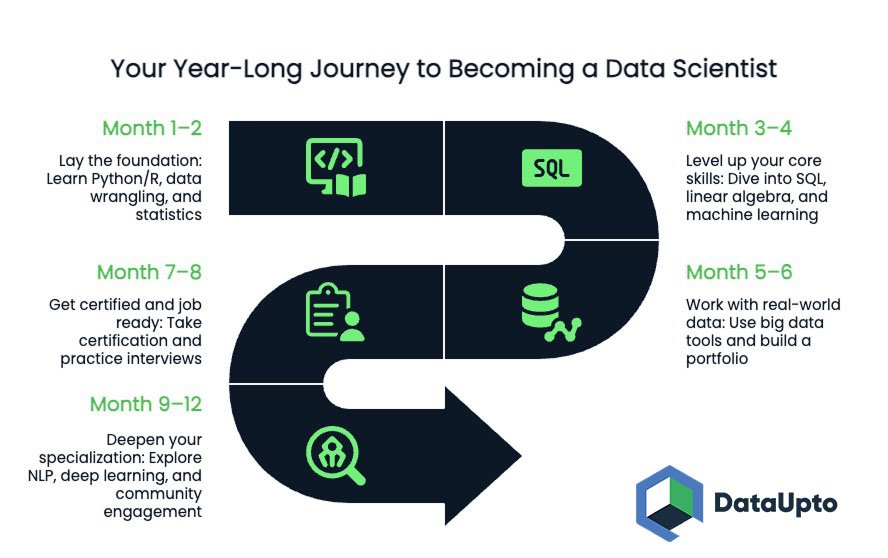
2. Month 3–4: Dive into machine learning and
3. Month 4–5: Learn databases and big data tools
4. Month 5–6: Build real-world projects and a portfolio
5. Month 6+: Start job hunting and networking
6. Ongoing: Stay current and get certified
In this post, we’ll take a look at each of these points in more detail, giving you everything you need to know to get started on your journey to becoming a data analyst. You can find out about the top analytics careers in a separate post.

We have a whole article dedicated to understanding data science. In there, we explore the role a data scientist may take. Essentially, data scientists work to deeply understand and analyze data to provide actionable insights.
In a business environment, they work across multiple teams to lay the foundations for robust analytics. This means developing strategies to capture, gather, and clean data from various sources. After organizing and exploring this data, they can then build solutions and communicate their findings to the wider business.
Data scientists often work with other professionals, including data engineers, analysts, IT architects, application developers, and business stakeholders.
There are many reasons why someone may choose to pursue a career in data science. It’s an industry that can be immensely rewarding, providing an intellectually challenging and stimulating environment. Data scientists must keep ahead of the latest technological trends and developments, working in an often dynamic setting.
So, if you’re intellectually curious, have an analytical mind, and love working with data and technology, becoming a data scientist could be for you.
Furthermore, there are many job opportunities for talented data scientists. Data from Statista shows that the big data market is expected to grow significantly in the coming years, predicted to be worth $103 billion in 2027 compared to $90 billion in 2025.
Similarly, The US Bureau of Labour Statistics predicts a 36% rise in data science industry jobs between 2023 and 2033, far higher than the 4% national average.
This growth is reflected in the popularity of data science careers, with organizations such as the U.S. News & World Report ranking data scientists as the #4 best job in technology, #6 best in STEM jobs, and #8 best overall job.
If you’re still not convinced why you should think about this career, the average data scientist salary could be appealing. With a median salary of over $125,000 per year, it’s clear to see that the demand for data scientists is met with a generous pay package
These are the technical skills you’ll need to develop to become a fully-fledged data scientist:
These are now usually referred to as ‘power skills’ or ‘human skills,’ and they are cross-functional skills that aren’t job-specific but are still necessary. For a data scientist, these include:
By now, you’re likely eager to start your journey to becoming a data scientist. But where to start? Below, we’ve highlighted eight steps you need to take to become a data scientist from scratch.
As we’ve discussed already, the exact data scientist requirements will depend on a variety of factors, but these are some of the most commonly cited steps:
As you work to become a data scientist, you’ll often encounter large and complex datasets. To make sense of this information (for yourself and others), you’ll need to learn how to deal with it. This is where skills in data wrangling come in handy. This is where you’ll clean, organize, and transform raw data into a format from which you can analyze and draw conclusions.
You can use various tools to wrangle data, but libraries like Pandas in Python are often the go-to choice. You can check out our data wrangling in Python with pandas cheat sheet for more info.
When it comes to presenting your data with impact, you’ll need to master reporting and data visualization. You can learn more about some of the best data visualization tools out there, giving you a range of options depending on your ultimate goal.
The popular belief is that to start learning data analysis, one has to be good at mathematics, statistics, or programming. While it’s true that a background in these fields provides a solid technical basis, it doesn’t mean that a career in data analysis is unapproachable for people from other educational and professional backgrounds.
Learning to analyze data will require some intensive study, dedication, and a great deal of practice. You have to maintain a certain level of optimism even when you are stuck, exhausted, discouraged, or can’t see any progress.
An aspiring data analyst should be creative and curious about data, have an exploratory mindset, be able to think analytically, be able to work both independently or in a team and be willing to dedicate the necessary time and effort. These are all qualities that will help ensure your success.
You’ll want to start by mastering some basic data analysis skills, such as the fundamentals of statistics, which covers topics such as including measures of center and spread, probability distributions, and hypothesis testing.
You can also start with things like data analysis in spreadsheets to get a feel of collecting and wrangling, and learn how exploratory data analysis in Power BI and other tools works.
While you don’t necessarily need a degree covering these fields, you need a functional knowledge of these areas. Generally, you’ll want to cover areas such as calculus, linear algebra, and statistics. However, it’s worth assessing your intent behind learning these things.
For example, learning calculus can help you learn to create optimization algorithms for machine learning, although there are functions in both Python and R that can take care of the calculus for you. As a specific example, understanding a topic like gradient descent can help you measure the change in a function’s output when you tweak the inputs, which can help refine machine learning models.
If you’re looking to brush up on your linear algebra skills, our Linear Algebra for Data Science in R course can help you work with vectors and matrices, solve matrix-vector equations, perform eigenvalue/eigenvector analyses and use principal component analysis to do dimension reduction on real-world datasets. These areas are all useful for applied mathematics and data science.
Similarly, Intermediate Statistical Modeling in R covers some essential machine learning statistics topics, helping you progress in key areas.
In our article on the top programming languages for data scientists, we explore in detail some of the best languages you should consider learning right now. Given their versatility and ubiquity, two of the most obvious choices for data scientists are Python and R.
Of course, working with data also means working with databases, so SQL is another essential programming language. Thankfully, it’s a relatively straightforward language once you’ve learned Python and R.
Julia is a good choice once you’ve learned Python, R, and SQL. With Julia, you get a language that’s built from the ground up for data science, making it fast and intuitive. If you start working with very big data sets, you may need other languages, but until then, these four will be sufficient.
With a language like Java, you get an open-source language known for its efficiency and performance. For data science, Java Virtual Machines provides a solid and efficient framework for popular big data tools like Hadoop, Spark, and Scala.
Other coding languages worth learning for data science with very large data sets include Scala, C/C++, JavaScript, Swift, Go, MATLAB, and SAS.
Once you’ve mastered some of the essential skills, you’ll need to start developing them on your own. There are a variety of ways you can do so:
You will have abundant opportunities to put your new skills to work by doing various exercises and completing the data analysis projects suggested by your curriculum. Practicing your skills and solving mock or real-world problems will give you a solid basis for your future work experience.
At this stage, having access to some real, clean datasets and preselected ideas to explore will help maintain your interest in learning and avoid the distractions of additional searching or brainstorming. You can look at our range of data analytics projects to help you put your skills to the test.
However, the time will come for you to prepare yourself for real-world work experience as a data analyst, and you’ll need to proceed with more advanced studies: In order to best “sell” yourself, you’ll want to showcase your ability to work and research independently to a potential employer.
Hence, you will need to undertake individual projects where everything will be your responsibility: selecting the topic, fetching the necessary data, contemplating the direction of your research, designing the project structure, making and checking hypotheses, effectively communicating your findings, and laying out the way forward.
As a result, individual projects usually take much more time than the guided ones, but they will help you to stand out from the crowd when applying for a job.
As soon as you come up with a good topic to develop in your project, your next step is to find the relevant data to explore. For this purpose, there are numerous online repositories offering a variety of free datasets. As well as Dataupto projects, you can use:
| Qualification Route | Pros | Cons |
|---|---|---|
| University Degree | – Comprehensive curriculum – Networking opportunities – Recognized credential | – Time-consuming (2-4 years) – Expensive ($30,000-$200,000) – May include unrelated courses |
| Online Bootcamps | – Focused curriculum – Shorter duration (3-6 months) – More affordable | – Less recognized than a degree – Intense pace – Limited networking |
| Self-Study (Online Courses) | – Flexible schedule – Wide range of topics – Cost-effective | – Requires self-discipline – Credentials varies by provider – Hands-on experience depends on the course |
| Certifications | – Validates specific skills – Quick to complete – Widely recognized | – May require prior experience – Costs can add up – Narrow focus |
We mentioned SQL in the topic above, and it’s a point that bears repeating. Relational databases allow data scientists to store structured data quickly and efficiently. When collecting and organizing data, you’ll often find that SQL is your preferred tool here.
SQL allows you to handle structured data, query databases, wrangle, prepare, and experiment with data, and more. Moreover, SQL is often deployed alongside Python, with libraries like SQLite, PostgreSQL, and MySQL helping you connect different data sources. Get started with the SQL Fundamentals skill track.
For example, Dataupto provides a collaborative cloud-based notebook that allows you to analyze data, collaborate with others, and share insights. DataLab is designed to take you from learning data science to doing data science. It also has built-in datasets, so you can analyze data within minutes.
You can also apply your knowledge to various data science projects, allowing you to solve real-world problems from your browser.
Once you’ve developed all the skills mentioned above, you’ll want to apply them in more professional settings. Once you’re confident you have the data scientist skills needed to meet the expectations of a role, you can start applying for internships or jobs.
Check out our full guide on applying for data science jobs and learn how to set yourself apart from other candidates. You’ll likely need a fairly thorough portfolio demonstrating a range of skills, and you’ll also need to prepare for the data scientist interview ahead of time.
If you want to become a data scientist, you will need to keep up-to-date with a fast-paced industry. There is no better way to stay informed about developments in data science than by engaging with what can often be a generous and dedicated community.
Along with social media sites such as LinkedIn, Twitter, Discord, and Reddit, you can follow all kinds of niche sites, blogs, and data science leaders. Look for people who are interested in the same areas as you, reach out for advice and contribute to discussions, and get involved with what’s going on. And, of course, check out the DataFramed Podcast to get industry news from a host of data professionals.
Becoming a data scientist is a journey that can start from various educational backgrounds. As we’ve discussed, a bachelor’s degree in data science, computer science, or a related field is often the first step that people take. Still, in reality, there are multiple paths to gain the necessary skills:
The time it takes to become a data scientist depends on your starting point, background, and learning style. For complete beginners, reaching job readiness usually takes 6 to 12 months of consistent study and hands-on practice. If you already have a background in math, programming, or analytics, you may be able to accelerate this timeline.
Those pursuing a traditional academic route—like an undergraduate or master’s degree—may spend 2 to 5 years building their foundation. However, many successful data scientists break into the field more quickly through self-directed learning, bootcamps, and certifications.
No matter the path, the key is consistent progress in core skills (like Python, statistics, and machine learning), project work, and engagement with the data science community.
Here’s a simplified learning roadmap to help guide your journey to becoming a data scientist. While timelines vary, this plan assumes you’re starting from scratch and learning part-time
The path to becoming a data scientist is as exciting as it is rewarding. With data science permeating every sector and industry, the role of a data scientist has never been more crucial. Whether you’re driven by intellectual curiosity, the promise of a lucrative salary, or the desire to make impactful data-based decisions, a data science career offers endless possibilities.
As we’ve explored in this comprehensive guide, multiple avenues exist to enter this dynamic field. From formal education in computer science or statistics to self-directed learning through online courses, tracks, and certifications like those offered by Dataupto, the journey can be tailored to fit your needs and preferences.
The job market for data scientists is booming, with significant growth predicted in the coming years. This growth is not just in terms of job opportunities but also in the variety of roles and specializations within the field. Whether you see yourself as a data wrangler, a machine learning engineer, or a business intelligence analyst, there’s a niche for you.
So, if you’re analytical, enjoy problem-solving, and are intrigued by the power of data, there’s no better time to become a data scientist. Get started today with our Data Scientist with Python career track.